AI
IP and Novelty in the Age of AI
Bier is right about which moats matter. Where I think he’s myopic is the timeline.
Nikita Bier, a former Head of Product at X, recently tweeted, “Technical moats are mostly over at this point.” In his view, the only moats left are proprietary data, network effects, or a physical component.
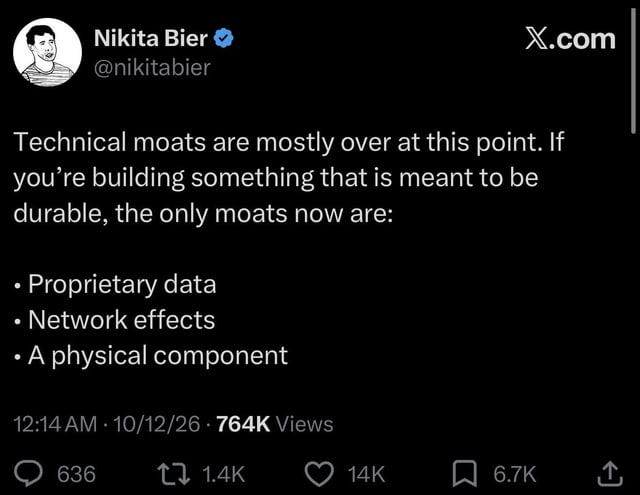
Bier is right about which moats matter. Where I think he’s myopic is the timeline. He’s describing AI as the thing that ended technical moats, but look at tech since 2000 and they were never that deep or wide to begin with.
Bier’s comment took me back to a conversation I had with extended family about AI. They were worried about AI becoming a new innovation engine. I explained that generative AI can’t invent anything truly new. Because it’s calculus and statistics, it can merely combine existing ideas into something ‘new.’
Google DeepMind researcher Tom Zahavy makes this argument in “Position: LLMs Can’t Jump”.
The paper states that induction, deduction, and abduction (defined as the creative leap that generates novel explanatory hypotheses/axioms from sensory or imagined experience), are all required for novel discovery and states that LLMs cannot sense and hence cannot abduct new experiences required or the intuitive step of Einstein’s model of scientific discovery.
That may seem disproven by OpenAI’s breakthroughs in mathematical proofs and Claude’s “discovery” of novel enzymes, but neither is as novel as it seems. Neither was made in a vacuum.
On the proofs, OpenAI used Lean, a programming language for formal proofs that flags incomplete or incorrect proofs and provides a toolchain for analyzing them. Lean is relatively obscure but powerful, and it was only a matter of time before an agent used its proof checker to rapidly churn through new proofs.
Claude reportedly “discovered” a CRISPR-like enzyme system in viruses. But as the New York Times reported, Dr. Mario Rodríguez Mestre, a biologist at the University of Copenhagen, first identified these enzymes in 2022, and his team had studied them for years without publishing. Mestre had also used Claude in his work, and he has publicly questioned whether Claude’s 21-hour agentic search was influenced by his team’s unpublished findings. Either way, the “discovery” wasn’t made in a vacuum.
The headlines are convincing, but they aren’t what they seem. Both are “code-shaped” or “training-shaped” problems, the kind LLMs have been trained to solve since the beginning.
Novel IP
Looking back on my career in SaaS, almost no company I’ve worked for had a deep technological moat. The “moat” was usually off-the-shelf technology, often open source, organized into a domain-specific schema or curated dataset. The only hard part was modeling the domain and the data deeply enough.
When we take even the most technically complicated business ideas, say, IPInfo.io for example, they claim to have the most accurate IP geo-location outside of MaxMind, dive in and they use probes from the regional IP registries and ML tech that’s widely published by PhDs.
For a less niche example, take Google’s ad tech. You might think Google has a technical moat there. After all, it’s the backbone of a $4.29T company. But Google’s moat isn’t a trade secret. It’s early arrival and high-quality execution (PageRank) on an obvious problem facing the young internet in 1998, followed by turning that ubiquity into a vertically integrated ecosystem that serves ads across platforms most of us use for free every day.
Though not central to the point, PageRank came out of scholarly research. Larry Page and Sergey Brin developed it as Stanford PhD students, building on decades of citation analysis, before leaving to start Google. Because the work happened at Stanford, the university held the patent, and the founders negotiated an exclusive license in exchange for over a million shares. The algorithm was also published openly, so anyone could read it and build on it.
Notice the playbook that actually gave both IPInfo and Google their moat — Broadly: Be first to solve a problem in a way that matters to users then capitalize on the ecosystem.
Domain Depth
Look at the range of those two examples: a niche SaaS with few competitors that does its domain well, and a giant with a $4T+ market cap. Both built their businesses on scholarly research that was free or cost the price of a journal issue.
True competitive IP comes from either lived experience or scholarly research. Lived experience is usually weak IP. Unless you have an unusual, deeply technical crossover, say computational biology, biochemical pathways and graph theory, plenty of others likely share your domain experience.
Scholarly research has a different problem. If the research team or university didn’t patent it, it’s free to anyone who can buy a journal issue, read the paper and point an agent at implementing it. From there, AI can easily handle the improvements needed to turn it into clean, patentable IP, even if it’s only an incremental gain on patented work.
Real Technological Moats
When I think of real technological moats, the kind that make it very hard for a competitor to cross over and attack the business, they usually aren’t in software.
Think of Coca-Cola’s secret recipe, ASML’s EUV lithography for chipmaking, or Xerox’s copier technology, which was so dominant that “xerox” became a verb. Each is a different story, but together they show how rare true technical moats are, and that even the real ones rarely last forever. Patents expire and secrets leak.
Coca-Cola began in the 19th century as a patent-medicine tonic before becoming a soft drink. Its formula was never patented. It’s a trade secret, and the company’s real moat today is as much brand and distribution as recipe. Xerox invented laser printing the same year as Woodstock, when protecting trade secrets meant security guards, locked rooms and owning production, not worrying about leakage through contract manufacturers in China, Indonesia or anywhere else with looser IP enforcement. ASML bet on EUV when other lithography makers were struggling, investing in a brutally hard scientific problem (EUV only works in a vacuum). Rivals like Nikon and Canon eventually backed out, leaving ASML with a technology so expensive and difficult to reproduce that only a handful of experts in the world understand it.
Notice that none of these moats is knowledge alone. They’re manufacturing, supply chains, physical hardware and brand, which is exactly Bier’s “physical component.” Outside of that, technical moats in tech have been thin for a long time.
Where Does This Leave Us?
Bier correctly argues that network effects, and proprietary data (often from network effects) are moats in tech. I’d argue, they have always been the primary moats in tech.
Technical moats didn’t go extinct with AI. They went extinct with Google, when open information started moving at light speed. You no longer needed library visits and card-catalog lookups that got you a 200 page book on the topic rather than the exact paragraph you needed.
The speed and volume of information exchange has already made innovation trivial in comparison to what came before it, so: Don’t believe the hype that AI is changing technical moats. They largely haven’t existed in a long time.
Going forward, true technical moats will belong to Renaissance men, secretive R&D labs in niche domains, and cross-domain experts who keep what they know to themselves. As Mestre’s story shows, that’s harder than ever.
Sources
- Nikita Bier on X, October 12, 2026
- Tom Zahavy, “Position: LLMs can’t jump” (ICML 2026)
- Lean
- IPinfo
- MaxMind
- “A cheap and accurate delay-based IP Geolocation method using Machine Learning and Looking Glass” (IEEE)
- Brin and Page, “The Anatomy of a Large-Scale Hypertextual Web Search Engine” (1998)
- US Patent 6,285,999, Method for node ranking in a linked database